By Elena Saavedra Buckley, Harper’s Magazine, 04.15.26
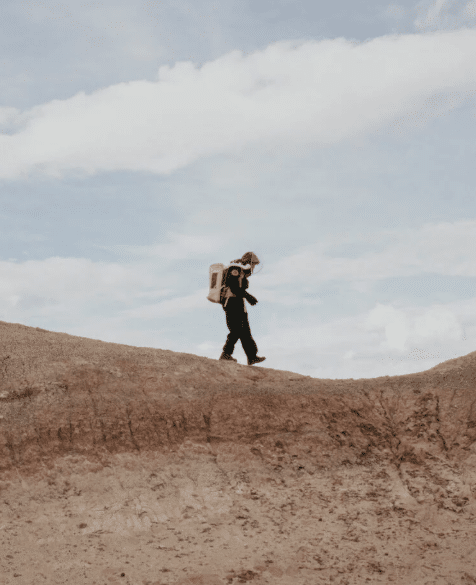
To become a Martian colonist, I first had to fill out a Google Form. It asked me about my aviation know-how, medical training, and experience “working in extreme environments.” I sheepishly wrote “N/A” each time, adding a note that highlighted my cooking and social skills. It turned out that this was okay: I was only going to Utah, after all, and the institution running the show was not a multibillion-dollar federal agency but the Mars Society, a scrappy nonprofit. The organization was founded in 1998 by the aerospace engineer Robert Zubrin to advocate for human settlement of the red planet. In 2002, it opened the Mars Desert Research Station, a simulated Martian settlement—laboratory, theater, and summer camp all at once. Located in a corner of rural southeastern Utah, the MDRS’s environment looks enough like Mars to play the part while still being accessible to participants and potential donors. (Antarctica and the Atacama Desert, arguably the best Martian analogues on Earth, are harder sells.)
I was accepted into a crew in late 2024, but our plans for a November launch date were quickly foiled when the man who was supposed to be our commander stopped replying to emails from mission support. Plenty of real-life space missions experience delays—over the thirty-year course of the U.S. Space Shuttle program, at least eighty missions were scrapped—but the obstacles here seemed avoidable. A month before we were meant to depart, Sergii Iakymov, the Ukrainian aerospace engineer who helps run the MDRS, told us our mission had been called off. “This decision is final,” he wrote. “We wish you all the best!”
Fortunately, there was another Google Form, and I managed to join a new crew that would be heading out in April. The commander of this mission, Dave, was a founding member of the Mars Society. He emailed to welcome me (“Howdy Elena”) and attached a photo of himself in aviator sunglasses, brandishing a small troll doll in front of the rotund white structure where we would soon be living together.
The MDRS is the longest-running Martian habitat in the world; more than three hundred crews have traveled there to live together, eat freeze-dried food, drive “rovers” through the desert in helmeted space suits, and work on research projects. Most Martian simulations are lengthy affairs: one conducting NASA-sponsored research on the slopes of Mauna Loa, in Hawaii, lasts at least four months, while NASA’s simulations at the Johnson Space Center, in Houston, span a full year. The longest-ever Martian simulation, beginning in 2010 at the Institute of Biomedical Problems in Moscow, went on for 520 days.
The Mars Society’s simulations, on the other hand, are usually two weeks long. Crew members’ research projects can seem a bit perfunctory, often involving testing gadgets or mimicking the sort of fieldwork that might someday be done on Mars. (This isn’t to say that the longer-term missions always produce mountains of technical research. In Russia, the six crew members played a lot of Guitar Hero, and mission control had to fake a fire to keep them alert.) Most participants are either graduate students or ordinary Mars enthusiasts, the majority of whom pay the Mars Society between $2,000 and $3,500 to attend. Only a handful of them have ever actually made it into space. It wasn’t initially clear to me what, exactly, the organization’s simulation had done to nudge humanity toward the red planet. It seemed more like an elaborate team-building exercise, a logistically complicated and expensive ropes course for space-travel diehards.
In the months before the mission, I attended regular Zoom meetings with my fellow crew members. There were two younger professionals in their thirties: Michael, who would be the crew’s engineer, and Koi, our health-and-safety officer. Then there were two retirees: Tim, who was serving as a “crew artist,” and Dave, who I learned had taken part in five previous MDRS simulations. These were people who could list every one of NASA’s rocket types, who had opinions on whether Mars was best reached directly from Earth or from a base on the moon. I would be the crew journalist, a traditional MDRS position best described as a kind of pro bono PR rep. My tasks would consist of writing daily summaries of our days on the planet that the Mars Society could then post on its website and Facebook pages. (I would also water the plants in the greenhouse.) Together we made up Crew 315, or, as we called ourselves, Crew Phoenix—a name that had been chosen by the rest of the team before I joined, supposedly for its connotations of rebirth; we wanted to revive a planet that may have once hosted life, but that had died long ago.
As our launch date approached, we prepared our proposals for research projects that could conceivably be completed in two weeks. The ones I designed were rudimentary, to say the least: one involved collecting samples of desiccated soil in order to, I claimed, “better understand how similar features on Mars might have formed”; the other had me monitoring a store-bought oyster-mushroom growth kit on a shelf in the greenhouse. We booked our flights and bought blue one-piece flight suits on Amazon that were almost certainly intended as Halloween costumes. We spent hours discussing the logistics of ordering customized mission patches.
To read the full article, please click here.
Images: Cassandra Klos