By Lou Farrell, Senior Writer, Red Planet Bound
Controlling rovers from hundreds of millions of kilometers away is challenging, to say the least. While they have become considerably more advanced in recent years, latency and bandwidth limitations can hold them back. The next generation of scientific discovery depends on making rovers smarter and more independent.
Edge computing capabilities for autonomous Mars rovers represent one of the few technological solutions that can support real-time decision-making outside of Earth’s orbit.
The Interplanetary Communication Delay
Mars is, on average, about 140 million miles away from Earth. This distance creates a significant communication lag, making real-time remote operation of rovers virtually impossible. Signals traveling at the speed of light take several minutes to reach Mars from Earth, with responses requiring several more minutes to return. Round-trip communication can range from six to more than 40 minutes, depending on orbital positions.
This delay means mission controllers can’t simply pilot rovers like remote-controlled vehicles. They must send a series of commands and wait to see the results. By the time ground teams realize a rover is heading toward a hazard, it may be too late to correct course.
Other Issues Complicating Communication
Beyond distance, space radiation poses another challenge. Interference from solar activity and cosmic rays can disrupt computing systems and corrupt data transmissions. These errors are particularly problematic because rovers run multiple computational workloads simultaneously, from navigation to scientific analysis.
Communication latency becomes even more critical for missions venturing beyond Earth’s orbit. Without the ability to rely on real-time guidance from ground controllers, spacecraft need powerful onboard computing resources to operate autonomously. This requirement has intensified as space agencies plan increasingly long and complex missions to distant destinations across the solar system.
The Evolution of Autonomous Mars Rovers
In response to the communication delay, rovers have become increasingly autonomous over time. In decades past, scientists planned rover routes in advance. Waypoints were typically no more than 330 feet apart to avoid any potential hazards, limiting how much ground rovers could cover in a single day.
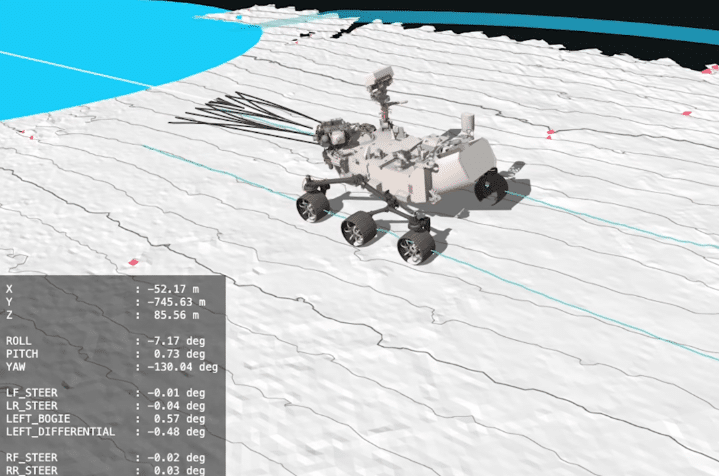
Modern technologies help autonomous Mars rovers operate more efficiently and dynamically. For NASA’s Perseverance rover, generative artificial intelligence analyzed terrain slope data and high-resolution orbital imagery. During its first run, it used the AI-generated waypoints to drive 689 feet. Two days later, it drove 807 feet — nearly twice as long as a standard rover without intelligent navigation.
The Technologies That Made It Possible
The capabilities of older rovers versus modern ones like Perseverance are stark. Data rates for the older radio systems on the twin Mars Exploration Rovers, Phoenix rover and InSight rover were limited to less than 256 bits per second. The Mars Reconnaissance Orbiter had to serve as a secondary relay to transmit larger volumes of scientific data back to Earth.
Advanced processors, algorithms and computing technologies enable rovers to act autonomously. Modern systems can process imagery onboard, identify obstacles and plan alternative routes without waiting for instructions from mission control. These advances represent a fundamental shift in how planetary exploration missions operate.
The Value of Real-Time Decision-Making
The ability to make decisions on the fly aligns with the core goals of Mars missions. Operating more efficiently and responding to challenging terrain increases the return of valuable scientific data. Rovers can pursue unexpected discoveries, adjust sampling strategies based on initial findings and navigate complex environments with greater confidence.
Even the brightest minds on Earth struggle to analyze data they can’t observe in real time. As scientists probe farther and autonomous Mars rovers become more bold, modern technologies will become increasingly necessary to enable truly independent exploration.
How Edge Computing Enables Onboard Intelligence
Edge computing technology is among the key drivers of next-generation space exploration. Processing data locally rather than relying on distant servers allows spacecraft to analyze information and respond immediately to their surroundings. This approach enables autonomous Mars rovers to handle complex computational tasks without waiting for instructions from Earth.
Overcoming Latency and Data Limitations
Edge AI has significantly improved mission efficiency by supporting autonomy and reducing communication latency, furthering scientific productivity and discovery. For spacecraft that collect and transmit information from remote locations with unreliable connectivity, establishing computing and storage at the edge is essential.
On Earth, edge computing supports near-instantaneous data transfers by eliminating the need to send data to the cloud or a central data center. By processing on-device or close to the information’s source, this technology lowers latency and operating costs.
It significantly lowers the demand on expensive and limited bandwidth by decreasing the amount of information sent back to Earth. Rovers can process raw sensor readings and imagery locally rather than transmitting everything to ground stations for analysis. Only the most relevant results get sent back, which preserves bandwidth for high-priority communications and scientific findings.
Powering a New Generation of Onboard Processors
The High Performance Spaceflight Computing project is developing a next-generation flight computing system to address computational performance, connectivity, fault tolerance and power management needs for future missions. This is a system-on-a-chip that delivers over 100 times the computing capability of existing space processors.
Edge computing supports AI inference, signal processing, data flow management and object classification directly onboard satellites and spacecraft, even at the edge of the solar system. Local processing allows systems to filter, compress and analyze information while lowering latency and reducing bandwidth bottlenecks. Before transmission, engineering teams use digital twin technology to simulate and verify commands for these advanced systems.
Paving the Way for a Full-Fledged Martian Internet
Years from now, when astronauts land on Mars, they will need a way to stay connected with each other, their equipment and with mission control back on Earth. Setting up a standard Wi-Fi router won’t be an option. Earth can be hundreds of millions of kilometers away from Mars, depending on where the planets are in their orbits.
No known strategies can eliminate the time lag in communications. Messages moving at the speed of light take anywhere from four to 24 minutes for a one-way trip. Cloud computing experts believe the Martian internet will extrapolate concepts from edge computing. Researchers have proposed a constellation of 81 low-orbit satellites that would function as an extension of Earth’s internet, providing planet-wide coverage.
Having information locally accessible is important, but redundancy matters just as much. Satellites would relay information to each other to maintain redundant backups. This approach means various landing sites on Mars would be able to connect with multiple satellites at any given time.
For extended missions, ground-based edge servers could be deployed for even faster information retrieval at habitation sites. Building such a system would require substantial resources, so constructing the constellation in stages would be necessary as human exploration of Mars advances.
Accelerating the Pace of Scientific Discovery
Whether planning for future rover missions or preparing for human landings on Mars, the time to build supporting infrastructure is now. Autonomous Mars rovers operating at the edge enable next-generation space exploration by improving autonomy and scientific productivity across missions while addressing the fundamental challenges of interplanetary communication delays.
As edge computing continues to advance, its applications will expand beyond rovers to support habitats, communication networks and resource management systems on Mars and beyond. The technology represents a critical foundation for sustainable solar system exploration.
Author’s Personal Note: I sometimes find myself getting frustrated when I’m trying to stream a show in the comfort of my home, and the connection lags. However, my small inconvenience is nothing compared to what scientists and astronauts are working to overcome with regards to the computing that powers network connectivity on Mars!
Images: NASA/JPL-Caltech and Shubham Dhage on Unsplash.