By Bill Maloney, Guest Writer, Red Planet Bound
Communicating rapidly and storing information are crucial for settling space, just as they were to our advancements here on Earth. Where would we be without the phone, computer, postal mail, or books? The Boston Post Road, once measured by Benjamin Franklin with an odometer attached to a carriage’s wheel, and committees of correspondence were vital for the colonists in the American Revolution. Books have inspired and educated many, spreading knowledge and wisdom far beyond the locales and eras of their authors. In times of emergency, phones provide us with lifelines. Computers are helping us cure diseases and explore the universe.
In 2026, we have grown accustomed to the ability to instantaneously connect with anyone throughout the world. However, as we expand our footprint beyond this planet, the speed of light will cause the speed of our communications to drastically slow down. The distance between Earth and Mars, as of October 18th, is 230,236,700 kilometers, or 143,093,040 miles. It takes light 12 minutes, 48 seconds to travel this distance.1 This means that it would take almost 26 minutes for someone on Mars to ask someone on Earth a question, for the person on Earth to, basically, immediately respond with a short answer, and for the person on Mars to receive the response.
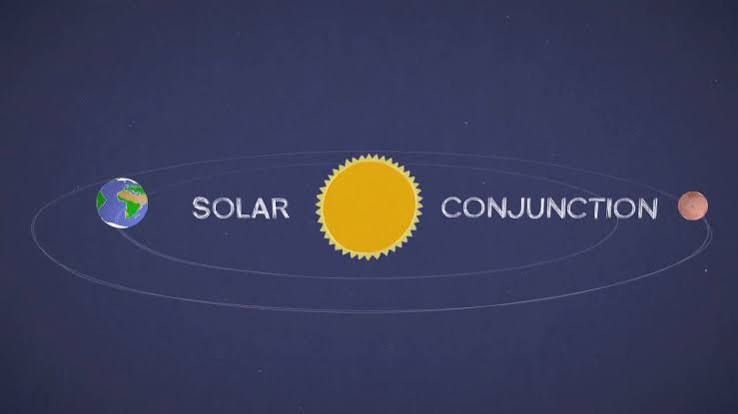
When Earth, the Sun, and Mars all line up in a straight path, with Mars and Earth on opposite sides of the Sun, it takes light twenty-two to twenty-four minutes to travel between Earth and the Red Planet. This specific ordering of the planets and the Sun occurs during a solar conjunction, specifically a superior conjunction. Another type of conjunction is an inferior conjunction, during which a planet with an orbit smaller than Earth’s passes between the Sun and Earth. Mars is a superior planet, meaning that it has an orbit larger than Earth’s, so it only has superior conjunctions. These are referred to as Mars solar conjunctions.2 If Earth passes between Mars and the Sun, it is called an opposition.
According to NASA, a Mars solar conjunction “occurs approximately every 26 months.”3 The most recent one was on January 9th of this year. The next one will occur on March 21st, 2028 (UTC). Mars solar conjunctions last for approximately two weeks.
Each of the last three years, from 2024 to 2026, I have been a part of the mission support teams for the analog mission crews at the Flashline Mars Arctic Research Station on Devon Island in the Canadian Arctic. We have simulated communication delays, mirroring what they would be if the crews were actually on Mars. These delays have impacted the way in which we communicate. Our questions and responses were full of information, and crews and mission support teams were proactive in sharing as much as possible with the other group.
Each team tried to anticipate the other team’s needs. Such exercises are essential practice for us at this moment in time.
NASA says that “[r]adio transmissions between the two planets during [a Mars solar] conjunction are at risk of being corrupted by the sun’s interference, so NASA Mars missions have a moratorium on sending commands to spacecraft on the surface of Mars or in orbit around Mars”4 during these time periods. During the November 2023 Mars solar conjunction, Newsweek reported that while NASA would “receive brief health updates from the rovers throughout this period,” there would be “a two-day stretch where Mars will be entirely hidden behind the sun’s disc and the rovers will be totally unreachable.”5 The time during which Mars is completely behind the sun’s disc is known as an occultation. Researchers from NASA’s Jet Propulsion Laboratory who projected Mars solar conjunctions from 2015 to 2026 wrote in a 2001 report that an occultation would occur only once during this period, in 2023.6
During a Mars solar conjunction, radio waves between Earth and the Red Planet have to go through the solar corona, which is the outermost part of the Sun’s atmosphere, extending to the Alfvén surface. The Alfvén surface was measured in April 2021 by NASA in its Parker Solar Probe as being 18.8 solar radii, approximately 8,134,600 miles7, or 13,091,300 kilometers8, away from the Sun’s surface.
The solar corona is made up of plasma, which is commonly referred to as the “fourth state of matter.” One way to view temperature is that it measures particles’ kinetic energy.
Because of the extreme temperatures in the solar corona, atoms collide at unusually high velocities. Electrons, which are negatively charged, become unbound to particles because of these collisions. Thus, atoms that were up until this point neutral are ionized. Hydrogen makes up approximately 73 percent of the Sun’s mass.9 Hydrogen atoms contain only one electron. When they lose it, they become a cation, which has a positive charge. The sun’s magnetic field has a large impact on solar plasma, with NASA saying that “[w]e can observe the shape of the magnetic fields above the sun’s surface because they guide the motion of that plasma”10 and ScienceDirect stating that “[t]he solar magnetic field controls the dynamics and topology of all coronal phenomena.”11 ScienceDirect also states that “[h]eated plasma flows along magnetic field lines and energetic particles can only propagate along magnetic field lines,”12 while “[c]oronal loops are nothing other than conduits filled with heated plasma, shaped by the geometry of the coronal magnetic field.”13
Communications are interfered with during a Mars solar conjunction in a multitude of ways, including signal scintillation, group delay, refraction, and solar radio noise. During signal scintillation, both uplink radio waves, those from Earth to Mars, and downlink radio waves, which travel in the reverse direction, experience scattering of their amplitudes and phases.
What starts off as a uniform, clean wave becomes corrugated and uneven as it travels through the solar corona. This is because the regions of the solar corona have varying levels of electron density. These variations alter the plasma’s refractive index, resulting in accelerations and delays of the waves, as well as their continuous bending.
In contrast to water and glass, whose refractive indices increase when the density of their electrons increases, plasma’s refractive index and the density of its electrons have an inverse relationship. The bound electrons of glass and water act as brakes on light, slowing it down, while plasma’s unbound electrons do the opposite. A low refractive index results in radio waves being pushed away from the Sun.
This increases the difficulty of tracking Mars, and NASA’s Deep Space Network must continuously adjust the angle of its antennas. If the radio wave’s refraction angle, which is the difference between the angle at which a wave travels when unimpeded and the angle it travels when it is impeded, is larger than that of an antenna’s beam width, which measures how wide its cone of sensitivity is, there could be a loss of boresight tracking. When this happens, the antenna is no longer lined up with the signal it is trying to receive, and communication is interrupted.
The delay of communications resulting from the distance between Earth and the Red Planet is exacerbated when a radio wave moves through the corona’s dense pockets of electrons. Waves can travel individually or in groups. When a wave travels on its own through plasma, it travels faster than the speed of light in a vacuum. However, a wave that travels as a group through plasma does so at a speed slower than the speed of light in a vacuum. These groups, known as wave packets, carry information. The deceleration of the speed that a wave packet travels at while going through plasma as compared to when it travels through a vacuum causes a group delay. There is an inverse relationship between a wave’s frequency and the length of a group delay, with lower frequency waves having longer delays. Group delays can cause an observer to think that a distance between points has increased, leading to inaccurate directions for navigation. Additionally, group delays involving waves of different frequencies can result in the distortion of data.
Thermal radio waves are emitted by the Sun at such an intensity that they create a noise that substantially interferes with radio waves passing by its corona. Emissions of plasma and solar radio bursts are additional examples of solar radio noise. In a Mars solar conjunction, an antenna’s beam experiences an increase in its noise temperature because of solar thermal radio waves. This increases the static interfering with a receiver as it tries to listen for a signal, and does so to such an overwhelming degree that the signal can no longer be heard and communications stop.
We must develop technology and protocols that address the communications issues arising from Mars solar conjunctions.
Valuable technologies include Ka-band, or 32 GHz, hardware, as well as those that support optical communications systems and disruption-tolerant networking. Examples of hardware that would be helpful for communication across a 32 GHz spectrum are plasma-tolerant transceivers, wave tube amplifiers, low-noise amplifiers, and dishes that have been improved on with regards to increasing gain and narrowing beam focus. Improvements in near-infrared fiber lasers and vibration isolators are necessary for optical communications systems to be set up. Required improvements in disruption-tolerant networking include increasing its capacity to transmit large quantities of data as well as its capacity to cache bundles of information, which is particularly important as “store-and-forward” is a central part of the network’s operations.
Protocols that help crews on Mars be self-sufficient during Mars solar conjunctions have to be developed. There should be substantial planning prior to these time periods. It is important that risk be minimized as much as possible. Before a Mars solar conjunction, an abundance of information and guidance should be shared with the crew. Artificial intelligence can also assist crews during these times. Additionally, all data collected should be stored locally.
Preparing for Mars solar conjunctions is essential in our efforts to settle Mars. Now, we have to think about ways to address the gaps in communication caused by them. We must develop the necessary technologies and protocols now. It is important that we appreciate the frontier that is Mars, while being confident in our ability to develop the tools we need to settle it.
Image: NASA/JPL-Caltech
1 Data sourced from TheSkyLive.com on October 18th, 2026.
2 https://science.nasa.gov/resource/geometry-of-mars-solar-conjunction/.
3 Ibid.
4 Ibid.
5 https://www.newsweek.com/mars-rovers-nasa-contact-solar-conjunction-1843050.
6 https://tmo.jpl.nasa.gov/progress_report/42-147/147C.pdf.
7 https://r74n.com/convert/?length/-/solar radius/mile.
8 https://r74n.com/convert/?length/-/solar radius/kilometer.
9 https://www.worldatlas.com/space/what-is-the-sun-made-of.html.
10 https://www.nasa.gov/science-research/heliophysics/nasa-understanding-the-magnetic-sun/.
11 https://www.sciencedirect.com/topics/earth-and-planetary-sciences/solar-magnetic-field.
12 Ibid.
13 Ibid.