The second half of Crew 19’s mission at the Flashline Mars Arctic Research Station on Devon Island (Nunavut Territory) highlighted the realities of long-duration exploration in one of Earth’s closest analogs to Mars.
As the analog mission entered its final days, the crew balanced demanding scientific research with habitat maintenance, equipment repairs, outreach activities, and daily operations under simulated Mars mission conditions. Despite mechanical setbacks, harsh terrain, and the logistical challenges of operating in the High Arctic, the team consistently adapted, demonstrating the resilience, problem-solving, and teamwork that future planetary explorers will require.
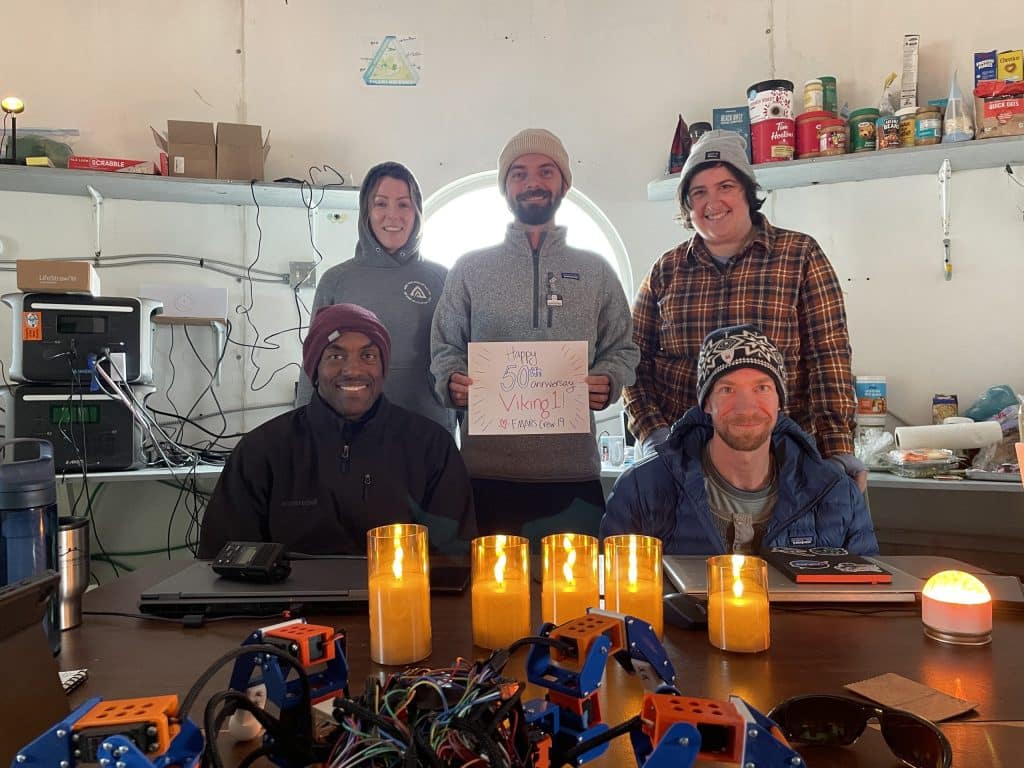
One of the defining moments of the latter half of the mission came as the crew commemorated two milestones in space exploration history: the anniversaries of the Apollo 11 Moon landing and the Viking 1 landing on Mars.
Between repairing the habitat and preparing a student robotics experiment, Crew 19 reflected on how Viking’s historic images forever changed humanity’s perception of the Red Planet. Standing amid the barren terrain of Haughton Crater, the team noted how strikingly similar the landscape appeared to Mars, reinforcing the importance of analog missions in preparing astronauts for future expeditions beyond Earth.
Scientific fieldwork intensified during the final days as the crew conducted extensive EVAs throughout Haughton Crater.
Among the mission’s most significant discoveries was an important impact breccia site containing mineral-rich samples that may provide new insights into the crater’s formation, cooling history, and ancient water chemistry dating back approximately 30 million years. Geological sampling was complemented by educational outreach, including a live virtual event with students in which the crew shared their experiences, encouraged young people to pursue STEM careers, and demonstrated how analog missions contribute directly to humanity’s preparation for Mars exploration.

Throughout these activities, the crew also contended with the realities of field operations, recovering stranded ATVs, repairing punctured tires, and overcoming unexpected equipment failures without allowing them to derail the mission.
The mission concluded with Crew 19’s final full day of simulated Mars operations, bringing weeks of planning and hard work to a successful close. Through creativity, determination, and collaboration, the team recovered every disabled rover, completed their final geological sampling objectives, and safely returned all equipment to the habitat.
More importantly, the crew recognized how much they had grown together. Skills that had once required careful deliberation had become second nature, allowing them to operate with greater confidence and efficiency while supporting one another through every challenge. Their reflections revealed that the mission had become about far more than accomplishing scientific objectives—it had become an exercise in trust, leadership, and shared purpose.
During their nightly “petals and thorns” discussions, each crew member reflected on the day’s greatest successes and challenges. Although their individual highlights ranged from breathtaking Arctic landscapes and scientific discoveries to personal breakthroughs and memorable EVAs, they all shared the same final “thorn”: none of them wanted the mission to end. Their collective desire to remain on Devon Island and continue exploring underscored the remarkable success of Crew 19.
By the conclusion of the simulation, the team had not only advanced important scientific research and operational testing, but had also strengthened the human skills that will be essential for future crews living and working together on Mars. Their experience at FMARS once again demonstrated the enduring value of high-fidelity analog missions in preparing humanity for the next giant leap into deep space.
To learn more about our Flashline analog program and the Mars Society, please visit: marssociety.org.