Access a PDF Version of this Statement
The Mars Society welcomes the sweeping set of policy announcements made by NASA Administrator Jared Isaacman at yesterday’s Ignition event. The decision to prioritize sustained surface operations on the Moon, to dramatically increase mission cadence, accelerate the development of space power, fly a Mars helicopter mission, and to develop a commercially driven logistics pipeline represents a fundamental and long-overdue reorientation of America’s human spaceflight program. For the first time in decades, the architecture being laid out by NASA reflects what the Mars Society has advocated for over thirty years: build the infrastructure, establish the supply lines, and open the frontier.
Surface First: The Right Call
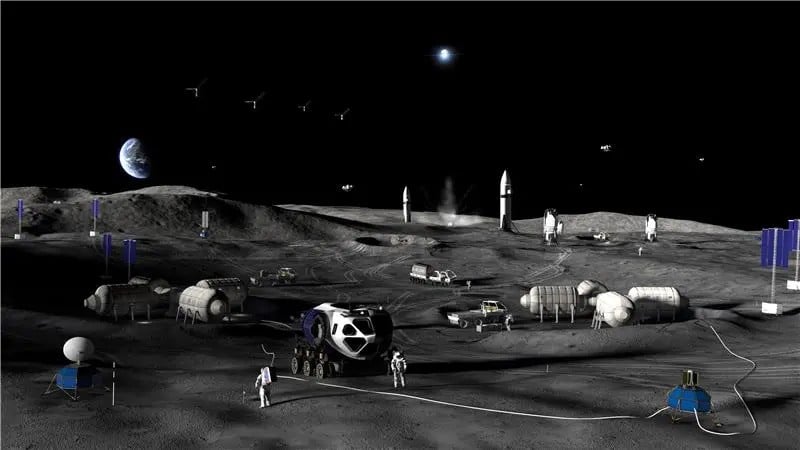
The decision to cancel the Lunar Gateway redirect its resources toward a permanent surface presence is exactly the kind of strategic clarity the program has needed. The Gateway was a costly detour that added complexity to lunar missions without benefit to either Moon or Mars missions. Administrator Isaacman’s phased approach—beginning with frequent robotic deliveries, building toward semi-habitable infrastructure, and ultimately enabling continuous human presence—mirrors the incremental, mission-driven architecture the Mars Society has long championed.
Critically, Isaacman stated that the lunar surface will serve as the proving ground for capabilities required for future missions to Mars. This framing is essential. Simply establishing a Moon base is not the end goal. We can use such an outpost to learn to live and work on another world, where we validate closed-loop life support, in-situ resource utilization, surface power systems, and the operational cadence of crewed deep-space missions. Every lesson learned at the lunar south pole brings us closer to boots on Martian soil.
Building the Railroad
We were struck by Administrator Isaacman’s choice of language at yesterday’s event. “We aren’t just returning to the Moon,” he said. “We are building the railroad that allows the private sector to follow.”
Those words carry a powerful historical resonance that the Mars Society has invoked for years. Just as the transcontinental railroad transformed the American West from an inaccessible wilderness into a landscape of opportunity, a reliable and frequent launch-and-delivery infrastructure would unlock the solar system for science, commerce, and settlement. Isaacman’s Ignition plan embraces this philosophy. The expanded CLPS program, the Lunar Terrain Vehicle procurements, the shift to commercially procured and reusable hardware for crewed flights, and the planned six-month landing cadence all point toward the kind of sustained logistics backbone that makes a permanent presence possible.
But while the proposed acceleration of mission cadence is necessary, the means that Isaacman will use to achieve it have not been made clear. The Artemis mission architecture remains incoherent. The success of Starship as a low-cost reusable heavy lift vehicle seems like a good bet, and with refueling it could well make its way to lunar orbit carrying large amounts of propellant or pother payloads. But Starship’s large mass makes it extremely suboptimal for use and as landing and ascent vehicle. What is needed is a much smaller reusable lander that runs on the same methane-oxygen propellant as Starship, so it can operate as an orbit to surface ferry refueled and supported by the larger vehicle. No requirement for such necessary system interoperability has been proposed. It needs to be.
Nuclear Power, Propulsion, and Mars
We are encouraged by the announcement of Space Reactor-1 Freedom, a nuclear electric propulsion demonstration mission to Mars targeted for launch before the end of 2028. This schedule may, however, be optimistic, which is a matter of concern in that Isaacman has proposed that this system be used to support the Mars helicopter mission planned for that year. A Mars helicopter mission is a brilliant idea, as it would build on the success of the Ingenuity mission the multiply the mobility of our robotic Mars exploration systems by orders of magnitude. But this mission can readily be done using existing propulsion systems. Making it contingent upon rapid development of space nuclear electric propulsion adds a large amount of programmatic risk to the helicopter mission for no defensible reason.
The 40 kWe nuclear reactor proposed for use in SR-1 Freedom would have a vital role in providing surface power for human Mars expeditions. But nuclear electric propulsion (NEP) offers no compelling advantages for either robotic or human Mars exploration. The place where NEP shines is supporting robotic science probes to the outer solar system. A SR-1 Freedom type spacecraft could do a terrific job exploring the Moons of Jupiter or Saturn, for example, as its NEP system would give it great ability to maneuver within such systems, while its high power would provide high data rate communications while enabling to engage in active sensing to penetrate the clouds of Titan or the ice layers covering the oceans of Europa or Enceladus.
Space nuclear power and propulsion should both certainly be developed. But their development should be done for the right applications, allowing them to serve as a tremendous asset for space science, rather than an unnecessary liability.
Our Role Going Forward
The Mars Society has spent over 25 years preparing for this moment. Through the Mars Desert Research Station (MDRS) in Utah and the Flashline Mars Arctic Research Station (FMARS) in the Canadian Arctic, we have conducted hundreds of analog missions that test the human factors, crew operations, and scientific workflows that will be essential for sustained surface operations on the Moon and Mars. Through the Mars Technology Institute, we are advancing research in areas directly relevant to NASA’s stated priorities: surface EVA operations, habitat systems, crew psychology, and in-situ resource utilization.
We call on NASA to draw on the deep reservoir of analog research data and operational expertise that the Mars Society and its partners have developed over the past quarter century. We also urge the agency to ensure that the phased lunar base architecture remains explicitly oriented toward Mars. The Moon is a stepping stone, not a destination. Mars is where the science is, Mars is where the challenge is, and Mars is where the future is. Every system procured, every habitat deployed, and every operations concept validated on the lunar surface should be designed with the advance towards Mars in mind.
A New Era Begins
For too long, America’s human spaceflight program has been defined by architectures that were too complex, timelines that slipped by years, and a lack of strategic focus. The Ignition initiative represents a genuine break from that pattern. By committing to surface infrastructure, by increasing cadence, by embracing commercial partnerships, and by putting nuclear power on a path to flight, NASA is laying the tracks of the railroad that will carry humanity to the Moon and to Mars.
The Mars Society stands ready to support this vision in every way we can.