By Lou Farrell, Senior Writer, Red Planet Bound Blog
Launch mass is expensive and limited, making it impractical to ship every future need from Earth for a Mars mission. A resupply run to the International Space Station can arrive within days if something needs urgent replacement.
A supply mission to Mars works on an entirely different timescale, since launch windows only open on an infrequent, fixed schedule dictated by planetary alignment.
In-situ resource utilization offers a different path. Future missions can use what Mars already has on hand, its atmosphere and its ice-rich soil, to manufacture what astronauts and their equipment need. Here are several techniques, ranging from proven to speculative, that could support self-sufficient Mars manufacturing.
Together, these technologies could transform Mars from a destination supplied by Earth into a place capable of supporting itself.
Oxygen Production from the Martian Atmosphere
Mars has a thin atmosphere made almost entirely of carbon dioxide, a composition that turns out to be useful. A microwave-sized instrument aboard the Perseverance rover proved this directly, using solid oxide electrolysis to split carbon dioxide molecules and release breathable oxygen.
The device operated on Mars across multiple seasons and lighting conditions. It generated oxygen 16 times before its mission concluded, and a scaled-up version could eventually produce the many tons of oxygen a crewed mission would need for breathing and as rocket propellant.
Because oxygen is heavier than the fuel it burns with, producing it locally instead of shipping it from Earth removes a substantial portion of the mass a mission would otherwise have to launch.
Precision Machining and On-Site Part Fabrication
Existing aerospace machining expertise translates directly to the fabrication and repair of parts on Mars. Working with tough-to-machine materials in aerospace, such as carbon fiber composites and high-strength titanium alloys, is already standard practice in terrestrial manufacturing, and those same materials are likely candidates for spacecraft components and mission hardware on Mars.
Precision matters just as much off Earth as it does in a machine shop back home, since thermal growth in critical components can lead to dimensional drift that throws off a part’s fit or function. Martian dust adds an extra layer of difficulty here, since its fine, abrasive grains can work into bearings and moving machine parts in ways that terrestrial shops rarely have to plan around.
A crew capable of machining and repairing hardware on-site, dust and all, would be far less dependent on spare parts shipped across millions of miles.
Locating and Extracting Subsurface Water Ice
None of Mars’s other manufacturing processes matter much without a reliable water source to draw on. Water ice is preserved beneath the Martian surface across a band of midlatitude terrain, buried too deep for the planet’s thin atmosphere to sublimate it away.
Mapping projects have combined data from multiple orbiters, using neutron spectrometry, radar, and thermal imaging, to chart where that ice lies at depths ranging from less than a meter to more than five meters below the surface.
That mapping work matters directly for mission planning, since a landing site chosen near shallow, accessible ice would let astronauts drill or excavate for water without hauling heavy equipment far from their habitat. Water pulled from that ice serves several purposes at once, supplying drinking water, breathable oxygen through electrolysis, and the hydrogen that feeds the Sabatier reaction described below.
Propellant Production via the Sabatier Reaction
Getting astronauts to Mars is only half the challenge, and bringing them home requires a substantial amount of fuel that would be impractical to carry the entire way. The Sabatier reaction offers a solution by combining carbon dioxide drawn from the Martian atmosphere with hydrogen extracted from water ice, producing methane and water through a chemical process discovered more than a century ago.
The methane becomes rocket propellant when paired with locally produced oxygen, while the water by-product can be recycled back into the system to generate more hydrogen. Mission planners view this approach as central to any Mars architecture that relies on methane-oxygen propulsion, since manufacturing the return fuel on Mars sidesteps the need to launch it from Earth entirely.
Regolith-Based 3D-Printed Construction
Building livable structures on Mars presents a similar mass problem to the fuel issue. Shipping conventional building materials across interplanetary distances would be prohibitively expensive, so researchers have turned to the Martian surface itself as a source of raw material.
One approach under active development uses high-powered lasers to melt local regolith, allowing it to cool and solidify into strong, ceramic-like structures without any material brought from Earth.
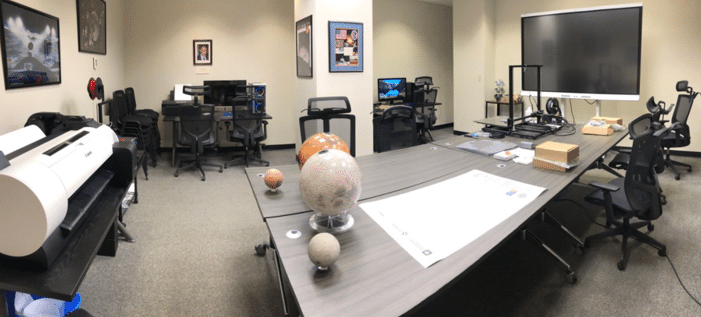
Research labs studying planetary construction now house full-scale equipment for this kind of work, including a large-scale robotic 3D printer built to test true-scale habitat construction using simulated regolith. Robotic systems could construct landing pads and habitat shells before a crew ever sets foot on the planet.
Sulfur Concrete Habitats
Mars presents another candidate for building materials, made from resources already on its surface.
Sulfur is relatively abundant across the Martian surface, and researchers have found that melting sulfur and mixing it with local regolith produces a strong, concrete-like composite often called Marscrete. Unlike traditional cement, this process requires no water, which is a scarce and valuable resource on Mars.
Laboratory testing with simulated Martian regolith has shown that the compressive strength of sulfur concrete can rival or exceed that of standard construction concrete on Earth. The material is also thermoplastic, meaning it can be reheated and reshaped, which could prove useful for repairs or modifications to a structure long after it’s first built.
Metal Extraction and Smelting from Regolith
Further down the timeline, and still largely in the realm of early research, lies the prospect of extracting usable metal directly from Martian soil. Regolith across much of the planet contains iron oxide, the same compound responsible for its reddish color, along with smaller quantities of other metals.
Reducing that iron oxide to workable metal typically means either heating it with a carbon source in a carbothermal reduction process or passing an electric current through molten regolith to separate out metallic iron, and both approaches require substantial energy and specialized equipment that remain significant engineering hurdles on a power-limited planet.
If the process becomes practical, it would open the door to manufacturing structural components and spacecraft parts entirely from materials already present on the planet, closing the loop on a truly self-sufficient Mars manufacturing base.
Building a Foundation for Life on Mars
A functioning Mars settlement would likely draw on all of these techniques together, using locally produced oxygen and propellant to sustain a crew and fuel a return trip. Regolith-based construction and precision manufacturing handle the habitats and hardware that keep everything running.
Many of these same techniques are being tested on the Moon first, since a lunar mission takes days rather than months to reach and offers a faster, cheaper way to validate hardware before it gets trusted with a Mars deployment. As these technologies mature from small-scale demonstrations into full production systems, humanity’s ability to live and work on Mars will increasingly depend on what can be made there rather than shipped from Earth.
If Mars exploration continues to advance at its current pace, expect these manufacturing techniques to move from research papers to real hardware sitting on the Martian surface within the coming decades.
Author’s Personal Note: While it may be unlikely to start digging around on Mars and uncovering those crystals they make lightsabers out of (or other classic sci-fi materials), there is still an unbelievable amount that the Red Planet can offer us. It’s really exciting to think about, isn’t it?
Images: NASA/JPL & Center for Space Resources