By Bill Maloney, Guest Writer, Red Planet Bound
On Saturday evening, earthlings can look into the stars and see a planetary parade of six of our fellow planets in the solar system.
A planetary parade occurs when planets appear to line up along the ecliptic, an invisible path the Earth takes in its orbit around the Sun. This path is so named because it is when the Moon intersects it that an eclipse happens.
Every planet more or less travels along this path because of their shared origins. The gravity of a mostly molecular hydrogen cloud surrounding a recently formed Sun caused it to collapse after it reached its maximum possible weight and it, then, became a solar nebula. The original shape of a cloud developed into a flatter, disk-like shape after its rotation sped up. This disk, referred to as a protoplanetary disk, started to orbit the Sun. The gas and dust within it, over time, matured into planets.
In order of their position in the sky, from lowest to highest, skygazers will be able to view Mercury, Venus, Saturn, Neptune, Uranus, and Jupiter. Unfortunately, the Red Planet will not be visible.
The alignment will not match their distances from the Sun, but rather where they currently are in their orbit.
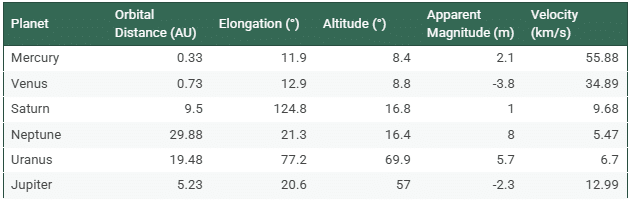
Also affecting the appearance of the planets is their elongation, which is the angle of the distance, measured in degrees, between a planet and the Sun, as observed from Earth.
Below is a table with the planets’ orbital distance, elongation, altitude, apparent magnitude, and velocity, as of 6:00 p.m. PST (UTC-8:00) on Saturday for a viewer of the planetary parade from Griffith Park in Los Angeles, California, where the Griffith Observatory is located.
The lower the apparent magnitude of a planet, the brighter it is. A planet’s altitude is directly related to its position above the horizon.
In order to best view the planets, one should try to get away from the lights of cities and go to a darker location. You have to look west, in the same direction of the setting Sun. The best timeframe to look towards the stars will be half an hour to an hour after sunset. During this time, the darkness of the sky allows for the planets to be viewed, including planets near the horizon that will soon dip beneath it.
Neptune and Uranus will require a pair of binoculars or a telescope to view. Astronomy apps, such as Stellarium, are also helpful. These apps provide sky maps that can help people identify planets against the backdrop of the constellations.
Star hopping is a technique that can be used to locate planets, especially Neptune and Uranus, since the fields of vision offered by telescopes and binoculars tend to be limited. By using a sky map and a brighter planet, like Venus or Jupiter, to serve as a reference point, the planetary alignment can be charted and come into better view.
Astronomical events like this planetary parade help us appreciate the beauty of the universe and its interconnectedness. The future shines like the stars in the sky with the promise of humanity expanding its footprint in the universe.
Happy stargazing to everyone! Enjoy the parade!
Table 1 February 28th, 2026 Planetary Parade Data
1 Heaven-Above.com‘s “Solar system chart” webpage provided measurements for orbital distance and velocity. The website’s “Planets” webpage provided measurements for elongation, altitude, and apparent magnitude, or brightness. On this webpage, the date was updated to February 28th, 2026 and the time was updated to 18:00:00. The location of Griffith Park was searched for on the “Change your observing location” webpage.
Image: NASA/Alyssa Lee